Article · Oct 8, 2026
3 challenges, 1 month: what a workplace, a gym and a public challenge showed us
95 of 102 staff joined in 11 days. The September numbers, the caveats, and 5 things worth copying with or without Welly.
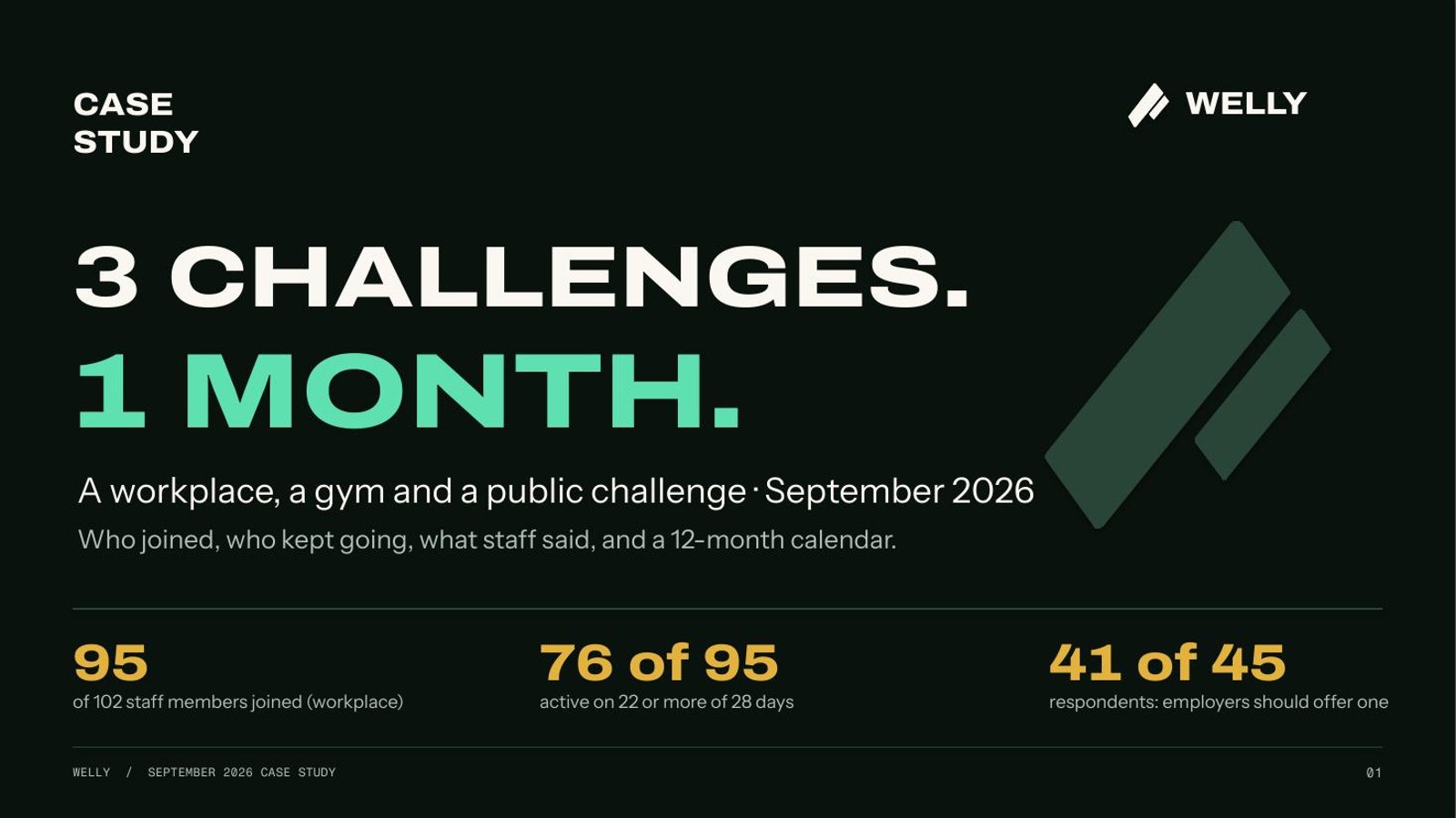
95 of 102 staff joined a workplace challenge in 11 days. The CEO launched it at an all-hands, with a QR code on the slide.
That was 1 of 3 Welly challenges that ran in September: a workplace, a gym and a free public challenge. Here is what each one showed, including the parts that did not go to plan. The full case study is a free download at the end.
One rule first. We report each challenge on its own and never pool the numbers. A workplace, a gym and an open public challenge are different crowds.
3 challenges, 3 different crowds
The workplace: 102 staff in the fitness industry. Launched by the CEO. 4 weeks, 31 August to 27 September, with points capped at 700 a week.
The gym: 107 members signed up. Built on steps, with a goal of 30,000 a week and no cap, so volume wins. 30 days, 1 to 30 September.
The public challenge: 91 people signed up. Free, open to anyone with the app, on the same 700-point cap. It is not a workplace, so treat it as a contrast, not proof.
A CEO, a QR code and 11 days
91 of the 95 had joined by launch day. The other 4 followed within 11 days. 8 of the 95 already used the app before launch.
A fair warning. This is 1 workplace, in the fitness industry, so a friendly crowd. It is not a benchmark, and your results will differ. The launch is still easy to copy.
76 of the 95 were active on 22 or more of 28 days
That is 80% of the people who joined. 42 of them cleared the weekly target in all 4 weeks.
First, what a target is. The organisation sets it in the app before the challenge starts, on the metric it chooses: points, steps, distance or activities. Everyone gets the same weekly target. When someone clears it, rewards unlock for them in the app.
The workplace and the public challenge both used 700 points a week. The gym used 30,000 steps a week. Here is how many people cleared the weekly target, week by week:
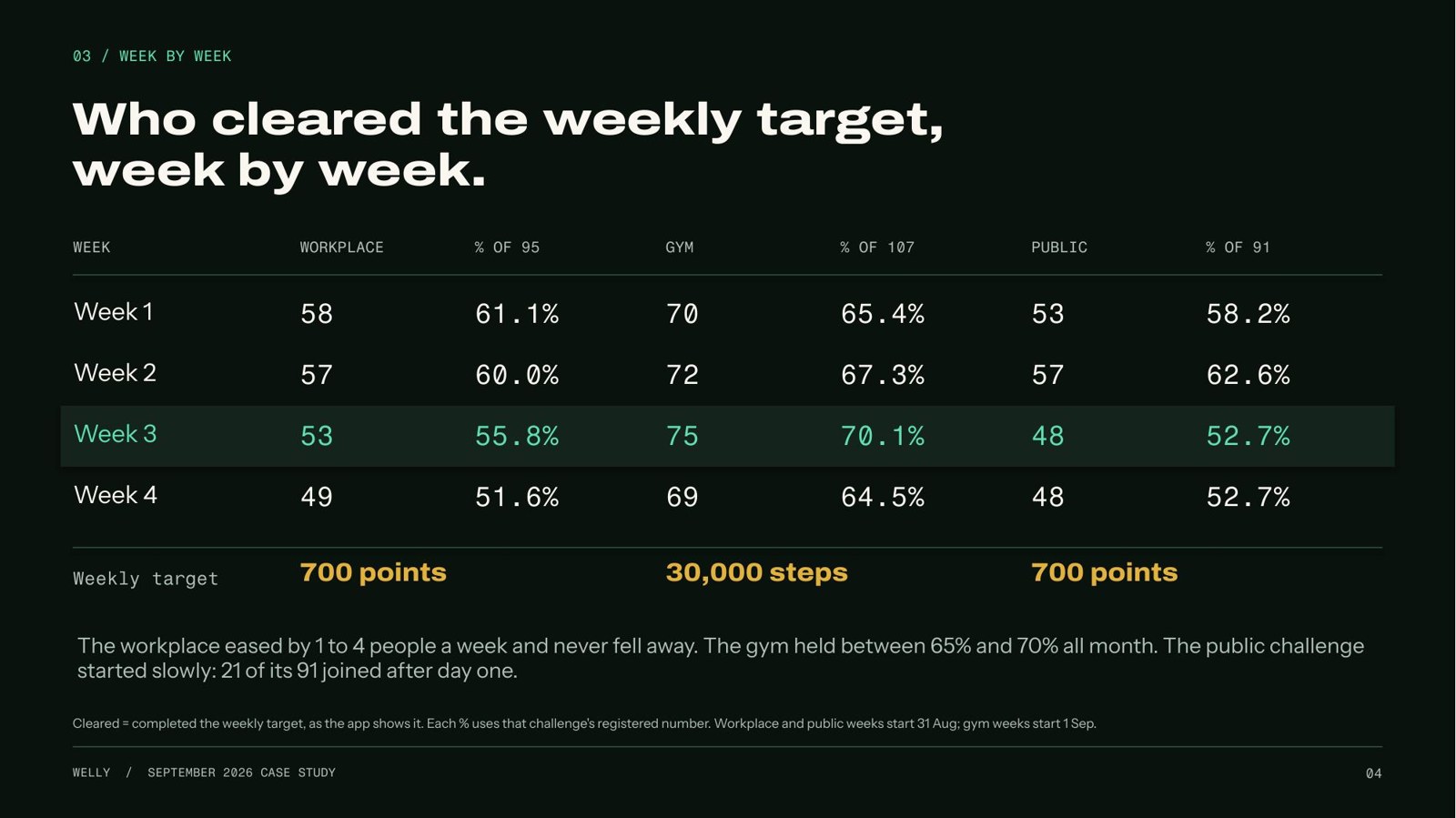
The workplace eased by 1 to 4 people a week and never fell away. The gym held steady. The public challenge started slowly, with 21 of its 91 joining after day one.
"Cleared" means completed that week's target, as the app shows it. We measured activity. Nothing here shows a change in health, absence, retention or productivity.
41 of 45 said their employer should offer one
After the workplace challenge we ran a short survey. 55 of the 95 who joined answered (58%). The answers are self-reported, with no baseline, and not everyone answered every question.
41 of 45 respondents said their employer should offer workplace challenges.
43 of 46 said points across a range of activities is the right model for a workplace challenge.
30 of 39 said the points model meant more people had a realistic chance.
"I didn't need to aim to win. Just see how I measured up alongside colleagues." (A participant, anonymous)
That is what people said, not a measured change in their wellbeing.
More activity, more tickets, and the biggest holder still lost
Every 100 points earns a ticket in a weighted draw. More tickets means better odds, never a guarantee. In all 3 September draws, the largest ticket holder did not win. The gym's winner finished 47th on the leaderboard and held 75 of 7,299 tickets, about 1%. Anyone taking part has a chance.
Rewards come built in. Welly includes 102 partner offers for milestones and giveaways, at no cost to you. Or bring your own, such as a team charity donation or a Wellbeing Day Off.
5 things worth copying, with or without us
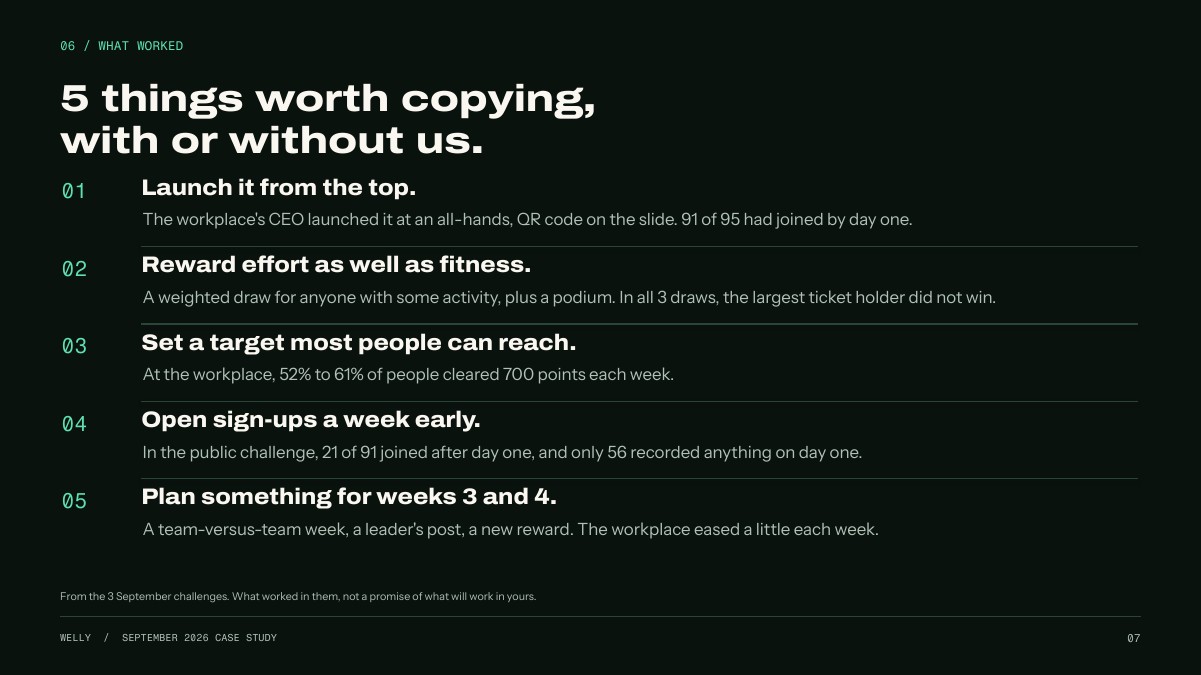
Launch it from the top. The workplace's CEO launched it at an all-hands, QR code on the slide. 91 of 95 had joined by day one.
Reward effort as well as fitness. A challenge can be set up to do both: a weighted draw where anyone with some activity has a chance, and a podium for the top performers. In all 3 September draws, the largest ticket holder did not win.
Set a target most people can reach. At the workplace, 52% to 61% of people cleared 700 points each week.
Open sign-ups a week early. In the public challenge, 21 of 91 joined after day one, and only 56 recorded anything on day one.
Plan something for weeks 3 and 4. A team-versus-team week, a leader's post, a new reward. The workplace eased a little each week.
These worked in the 3 September challenges. They are not a promise of what will work in yours.
One challenge is an event. Three become a habit.
A single event reads as a one-off. Three Seasons a year become something people expect. The case study includes a 12-month wellbeing calendar: plan in November, run Season 1 in February, Season 2 in May and Season 3 in August, with light months between. Season 3 ends before Steptember, so people can roll straight on.
The dates are a suggestion. Each Season is 4 full weeks, Monday to Sunday.
Get the case study
The full case study has the week-by-week numbers, the survey results, the draw and the 12-month calendar.
Download the case study (PDF, 10 pages)
It is built from anonymised platform aggregates, shared with the permission of the workplace and the gym. There are no individual records, and anything covering fewer than 5 people is left out.
If you would like to talk it through, a call takes 20 minutes, free, with no obligation. Bring your calendar and your headcount, and we will bring September's numbers. We will cover your people, your year and a participation target we agree up front. Use the Book a demo button below to choose a time.
More from the newsroom
Article · Apr 17, 2026
How to use wearable data to build a scalable corporate wellness reward system
Article · Feb 19, 2026
Why corporate wellness challenges fail, and what high-performing organisations do differently
Article · Feb 4, 2026
Team-based wellness challenges: the engagement and retention lever your competition is already using